
Skip content
Dojo Tutor
Log inTry class

Precalculus Tutoring

Personalized support from experienced teachers, with the flexibility of learning online.

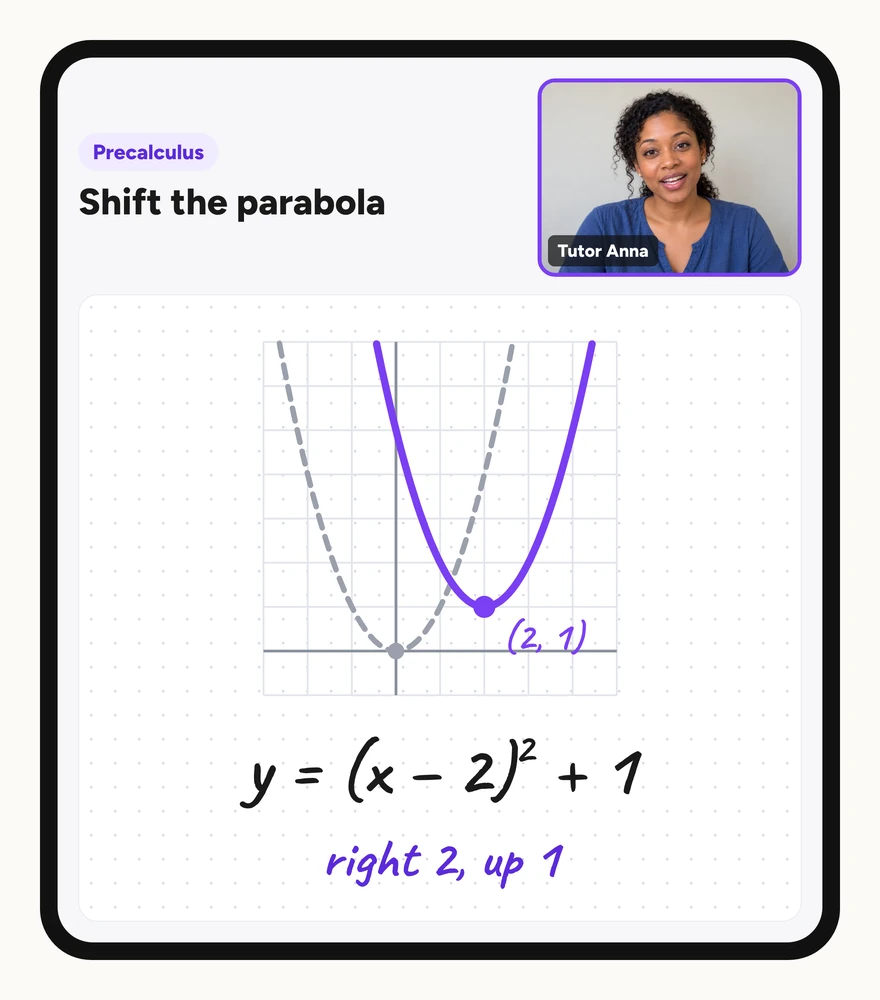
Illustration of an online precalculus lesson: a tutor on video and a graph showing y = x² shifted right 2 and up 1.

I have seen such a boost in her grades and confidence — Jessica S

Try a class

Top Precalculus Tutors

5 of 24 tutors shown · 5.0 avg rating from 1,679 reviews

Sun
Super tutor

5.0

191 ratings

7 years

Experience

5th - 12th

Available Mon, Tue, Wed, Thu, Fri, Sat

Hi! I’m a certified flight instructor and an Astrophysics major from UCF. I have extensive experience teaching both academic STEM subjects and…

6th - 12th

7 days a week

Hi! I became a Math teacher in 2017, and quickly learned how to reach individual students to bring out their best, even if they despise math.

6th grade

Available Sun, Mon, Tue, Wed, Fri, Sat

I am a high school math teacher currently teaching AP pre-calculus, AP calculus AB, and geometry. I am an avid supporter of my local NBA team as well…

6th grade

Available Mon, Thu

Can support: Gifted & talented

Hi! I have taught all levels of math and it brings me joy to help kids learn math. I love making connections for them. I enjoy sports and learning…

6th - 12th

Available Tue, Wed, Thu

Can support: ADHD, Dyslexia, Autism spectrum ...

I LOVE MATH and so does my cat Fibonacci!! I have been teaching for 13 years in the Chicagoland area, and have taught a variety of grades and…

Precalculus tutoring that connects procedures to mathematical reasoning

Precalculus students may know how to apply a formula and still get stuck deciding which form to use, when a rule applies, or why a solution method works. A vertical asymptote can feel like a memorized test for zero; trigonometric identities can become symbol manipulation without meaning; polynomial end behavior can reduce to pattern matching. Tutoring can start with the exact point where the procedure stops making sense.

Tutors can connect algebraic steps to function behavior, graphical features, and the conditions under which a technique is valid. Students might factor a rational expression to reveal a hole rather than an asymptote, rewrite a trigonometric expression by recognizing a quotient identity, or determine concavity by examining how rate of change itself changes. The aim is to give students a way to explain and verify each step, alongside practicing the calculation.

Why families look for Precalculus support

Earlier algebra skills are making new concepts harder

Factoring polynomials affects rational function simplification and finding zeros. Understanding function notation affects composition and inverses. Tutors can check these building blocks alongside current homework, then choose a smaller skill to revisit before adding transformations, asymptotes, or trigonometric identities.

The formulas are memorized, but their application is unclear

Students may remember to set a denominator equal to zero or apply a period formula without understanding what the result represents. Tutors can ask students to explain what a vertical asymptote means for the graph, why a leading coefficient determines end behavior, or how amplitude and period change a trigonometric function's shape.

Graphical features and algebraic forms feel disconnected

A parabola's vertex, a rational function's asymptotes, and a trigonometric function's transformations all connect algebraic structure to visual behavior. Tutors can help students move between representations, explaining how a coefficient in an equation affects the corresponding graph and why certain forms make specific features easier to identify.

Where students can get stuck in Precalculus

Confusing the sign of a leading coefficient with vertex type

A positive leading coefficient in a quadratic means the parabola opens upward and has a minimum point, not a maximum. Students may reverse this relationship. Tutors can connect the coefficient's sign to the graph's concavity: positive creates a U-shape with a lowest point, while negative creates an inverted U with a highest point.

Setting denominators to zero without simplifying first

Factor the numerator and denominator fully and record the original domain restrictions. After cancelling common factors, a remaining denominator zero gives a vertical asymptote. An excluded value at which the simplified denominator is nonzero gives a hole. Cancelling one copy of a repeated factor is not enough if another copy remains in the denominator.

Misidentifying which coefficient controls period or phase shift

In 2sin(3x − π) + 1, the amplitude is 2, the period is 2π/3, and the midline is y = 1. Factoring the inside as 3(x − π/3) reveals a shift right by π/3. Tutors can separate each transformation and check which part of the expression controls it.

Applying reciprocal identities without checking the context

Cotangent equals 1/tangent, but students may forget to rewrite the expression completely or lose track of the angle. When converting cotangent to tangent, the reciprocal applies to the entire tangent function of the same angle, and the calculation must respect order of operations and parentheses.

Recognizing a decreasing function but missing increasing rate of change

A function's output values can decrease while the rate of decrease itself slows, indicating concave-up behavior. Students may struggle to reconcile falling y-values with increasing average rate of change. Tutors can show that if differences shrink (say, −6, −4, −2), the rate is becoming less negative, signaling upward curvature even as the function descends.

Distributing coefficients incorrectly in polynomial or rational expressions

When multiplying through by a common denominator or distributing a negative, students may apply the factor to only part of a term. In solving rational equations by clearing denominators, every term—including those in parentheses—must be multiplied by the entire common denominator, and common factors then cancel before simplifying.

How Precalculus tutors make the next step clearer

Simplify rational functions before identifying asymptotes and holes

Factor both numerator and denominator completely, then cancel any common binomial factors. Values that made a canceled factor zero become holes (removable discontinuities). Values that make the remaining denominator zero—but not the numerator—are vertical asymptotes, where the function grows without bound. This distinction depends on simplification happening first.

  1. Factor the numerator and denominator completely.
  2. Cancel common factors that appear in both.
  3. Identify zeros of the simplified denominator as vertical asymptotes.
  4. Identify zeros of canceled factors as holes.
  5. Check the graph or a table of values near each feature to confirm behavior.

Determine concavity by examining how rate of change changes

Compare average rates of change over successive equal-width intervals. Rates such as −6, −4, and −2 are becoming less negative: the outputs fall while the sampled slopes increase. That pattern is consistent with concave-up behaviour over the sampled region. Tutors can connect the table to the curve and avoid treating a few data points as proof of behaviour everywhere.

Rewrite trigonometric expressions using quotient and Pythagorean identities

Recognize that sin²x can be written as (sin x)(sin x), allowing one factor to combine with another term. The quotient identity sin x / cos x = tan x then transforms the expression. Tutors can show that sin²x / cos x becomes (sin x)(sin x / cos x) = (sin x)(tan x), making the target form visible through strategic regrouping rather than memorized pattern matching.

Putting Precalculus skills into practice

Original examples of ways to connect algebraic form to function behavior.

From vertex form to identifying the minimum or maximum

Consider y = 2(x − 3)² + 1. The positive leading coefficient (2) means the parabola opens upward, so the vertex is a minimum. The coordinates are (3, 1) because the signs inside the parentheses flip. Students can sketch the U-shape, label the vertex, and explain why no maximum exists for this function.

From a rational expression to distinguishing holes and asymptotes

For f(x) = (x² − 9)/(x² − x − 6), factor to (x − 3)(x + 3)/[(x − 3)(x + 2)]. The original domain excludes 3 and −2. Cancelling gives (x + 3)/(x + 2): there is a hole at (3, 6/5), and x = −2 is a vertical asymptote. Students can check which restriction remains in the simplified denominator.

Inside a 25-minute session

What a Precalculus tutoring session can look like

This illustrative lesson focuses on finding and distinguishing vertical asymptotes and holes in rational functions. Tutors adapt the topic, examples, and pacing to match the student's current work and prior experience with factoring.

  1. 0–4 min

    Check factoring and simplification skills

    Review factoring a quadratic like x² − 5x + 6 into (x − 2)(x − 3). Confirm that students can identify and cancel common factors in a simple rational expression before introducing asymptotes and holes.

  2. 4–10 min

    Introduce the distinction between holes and asymptotes

    Explain that a hole occurs when a factor cancels from both numerator and denominator, while a vertical asymptote occurs when a denominator factor remains after cancellation. Use a concrete example: (x − 4)(x + 1) / [(x − 4)(x + 2)]. Cancel (x − 4) to identify x = 4 as a hole and x = −2 as an asymptote.

  3. 10–17 min

    Work through a new example together

    Factor and simplify a rational function such as (x² − 1) / (x² + 3x + 2). Students factor to (x − 1)(x + 1) / [(x + 1)(x + 2)], cancel (x + 1), and identify x = −1 as a hole and x = −2 as a vertical asymptote. Discuss what happens to y-values near each feature.

  4. 17–23 min

    Try an independent problem

    Present a new rational function and ask students to factor, simplify, and list all holes and asymptotes. Check their work step-by-step, focusing on whether simplification happened before identifying features.

  5. 23–25 min

    Review the process and choose next practice

    Recap the key steps: factor completely, cancel common terms, then identify holes from canceled factors and asymptotes from remaining denominator zeros. Choose a follow-up problem or return to factoring if that step remains uncertain.

Example timings only. The topic, depth, and pace change with the student's needs and the complexity of the rational expression.

Frequently Asked Questions

Terms of servicePrivacy PolicyNotice at Collection

© 2026 ClassDojo. All Rights Reserved.