


Skip content
Dojo Tutor
Log inTry class

Calculus Tutoring

Personalized support from experienced teachers, with the flexibility of learning online.

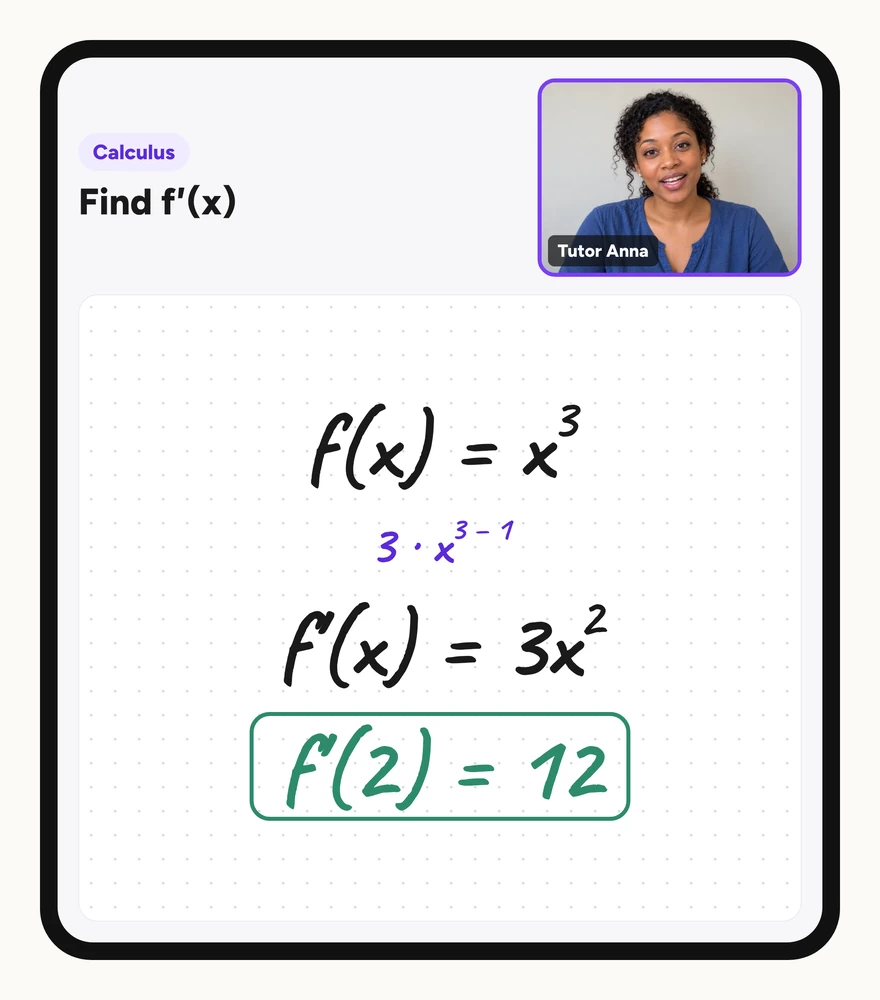
Illustration of an online calculus lesson: a tutor on video and a whiteboard using the power rule to find the derivative of x³.

I have seen such a boost in her grades and confidence — Jessica S

Try a class

Top Calculus Tutors

5 of 7 tutors shown · 5.0 avg rating from 1,018 reviews

Sun
Super tutor

5.0

191 ratings

7 years

Experience

5th - 12th

Available Mon, Tue, Wed, Thu, Fri, Sat

Hi! I’m a certified flight instructor and an Astrophysics major from UCF. I have extensive experience teaching both academic STEM subjects and…

6th grade

Available Sun, Mon, Tue, Thu

Can support: Gifted & talented

I am a dedicated and passionate educator whose professional journey spans the full spectrum from middle school to pre-university levels. Over the…

4th - 12th

Available Sun, Mon, Tue, Wed, Thu, Fri

Hello! My name is Ashtyn, and I am currently a medical student with a strong background in both math and science. I earned my bachelor's degree in…

6th grade

Available Sun, Mon, Tue, Wed, Fri, Sat

I am a high school math teacher currently teaching AP pre-calculus, AP calculus AB, and geometry. I am an avid supporter of my local NBA team as well…

All grades

Available Sun, Mon, Tue, Wed, Fri, Sat

Hi, I’m Mayowa, a dedicated professional tutor with extensive experience providing comprehensive academic support for students across all grade…

Calculus tutoring that connects the rule to the reasoning

Students may know a derivative rule and still get stuck deciding how to apply it. The chain rule can feel like multiplying by an extra term without a clear reason; implicit differentiation can become a list of steps; a negative sign can change an otherwise correct solution. Calculus tutoring can start with the exact point where the calculation stops making sense.

Tutors can connect written work to the structure of nested functions, the meaning of a derivative, and checks that confirm whether an answer is reasonable. Students might explain why the derivative of the inside function appears, verify a result by substitution, or use a sign chart to interpret what a derivative tells them about the original function. The aim is to give students a way to explain and check the next step, alongside practicing the calculation.

Why families look for Calculus support

The steps are familiar, but the reasoning is unclear

Students may remember to apply the chain rule or write dy/dx after a y-term without knowing why. Tutors can ask students to identify the structure of the function, explain what each part of the rule does, and connect the notation to the underlying idea.

Earlier skills are making new work harder

Trigonometric identities, factoring, and algebraic manipulation can affect derivative work and limit problems. Tutors can check these building blocks alongside current homework, then choose a smaller skill to revisit before adding another differentiation technique.

Where students can get stuck in Calculus

Understanding when the chain rule is needed

When a function contains another function inside it, the derivative requires the chain rule. For example, in (4x − 1)⁵, the outer function is something raised to the fifth power, and the inner function is 4x − 1. Students first differentiate the outer function, leaving the inside unchanged, then multiply by the derivative of the inside: 5(4x − 1)⁴ · 4, which simplifies to 20(4x − 1)⁴. Tutors can help students identify the nested structure before applying the rule.

Keeping track of notation in implicit differentiation

In implicit differentiation, treat y as a function of x and apply the chain rule when differentiating expressions involving y. The derivative of y² is 2y·dy/dx; the product rule gives d(xy)/dx = x·dy/dx + y. Tutors can collect derivative terms and isolate dy/dx where the resulting divisor is nonzero.

Applying trigonometric derivatives with correct signs

The derivative of tan(u) is sec²(u) · du/dx, using the chain rule. A common error is forgetting a negative sign when differentiating functions like −tan(x) or applying the derivative of cotangent. Tutors can ask students to write the derivative formula first, then substitute and simplify carefully.

Recognizing constants in derivative formulas

The number e is a positive constant, approximately 2.71828. In eˣ it is a fixed base, and the derivative is eˣ. In e⁻ˣ, the inner derivative contributes a minus sign, giving −e⁻ˣ. Tutors can separate the constant base from the variable exponent before applying the rule.

Choosing and applying an inverse trigonometric derivative

For differentiable u(x) with |u(x)| < 1, the derivative of arcsin(u) is u′/√(1 − u²). Tutors can help students select the correct inverse-trigonometric formula, identify u and u′, and check where the expression is defined. Different inverse functions have different derivative formulas and domain restrictions.

How Calculus tutors make the next step clearer

Identify the structure before applying the chain rule

Tutors can help students recognize an outer function and an inner function. In a problem like differentiating (4x − 1)⁵, the outer function is u⁵ and the inner function is u = 4x − 1. Students first differentiate the outer function with respect to the inside, giving 5(4x − 1)⁴, then multiply by the derivative of the inside, which is 4. This gives 20(4x − 1)⁴. Connecting the notation to the nested structure makes the rule easier to apply consistently.

  1. Identify the outer and inner functions.
  2. Differentiate the outer function, leaving the inside unchanged.
  3. Multiply by the derivative of the inner function.
  4. Simplify the result.

Use the product rule within implicit differentiation

When an equation contains a product of x and y, the product rule applies: the derivative of xy is x · dy/dx + y. Tutors can show students how to write dy/dx after each derivative of a y-term, collect all dy/dx terms on one side, factor, and divide. This keeps the notation consistent and the algebra organized.

Check increasing and decreasing intervals with a sign chart

First identify the function's domain. Critical numbers occur inside that domain where the derivative is zero or does not exist. Domain breaks also separate intervals for a sign chart, though an excluded point is not a critical number of the function. Tutors can check a derivative's sign within each interval and connect positive or negative values to increasing or decreasing behaviour.

Putting Calculus skills into practice

Original examples of ways to connect a practiced rule to a related problem.

From a power function to a nested function

Differentiate x⁵ to get 5x⁴. Then try (3x + 2)⁵. The outer function is still u⁵, so the derivative is 5(3x + 2)⁴, multiplied by the derivative of the inside, which is 3. The result is 15(3x + 2)⁴. Students can explain what changed and why the chain rule was needed for the second problem.

From a derivative to a verified critical point

For f(x) = x³ − 3x, the derivative is 3x² − 3. Setting it to zero gives x = −1 and x = 1. Testing x = −2, 0, and 2 gives positive, negative, and positive derivative values, respectively: the function increases, decreases, then increases on the three intervals. Tutors can explain why each interval needs a check.

Inside a 25-minute session

What a Calculus tutoring session can look like

This illustrative lesson focuses on applying the chain rule to a polynomial inside a power. Tutors can choose a different topic or adjust the pace to match the student's current work.

  1. 0–3 min

    Check understanding of basic power rule

    Differentiate x⁴ to confirm the power rule is clear. Try a simple problem without nested functions to check whether the notation and algebra are understood.

  2. 3–8 min

    Identify the nested structure

    Look at (4x − 1)⁵ and ask what the outer function is and what the inner function is. Discuss why the derivative will require more than just bringing down the exponent.

  3. 8–15 min

    Apply the chain rule step by step

    Differentiate the outer function: 5(4x − 1)⁴. Then multiply by the derivative of the inside: 4. Simplify to get 20(4x − 1)⁴. Explain why each step is necessary.

  4. 15–22 min

    Try a related problem independently

    Work on (2x + 3)⁶. Students identify the structure, apply the chain rule, and simplify to 12(2x + 3)⁵. Check the reasoning and the algebra.

  5. 22–25 min

    Review the structure and choose next practice

    Recap what makes a function nested and when the chain rule is needed. Choose another problem or return to identifying structure if the concept is still unclear.

Example timings only. The topic, activities, and pace can change with the student's needs.

Frequently Asked Questions

Terms of servicePrivacy PolicyNotice at Collection

© 2026 ClassDojo. All Rights Reserved.