

Skip content
Dojo Tutor
Log inTry class

Physics Tutoring

Personalized support from experienced teachers, with the flexibility of learning online.

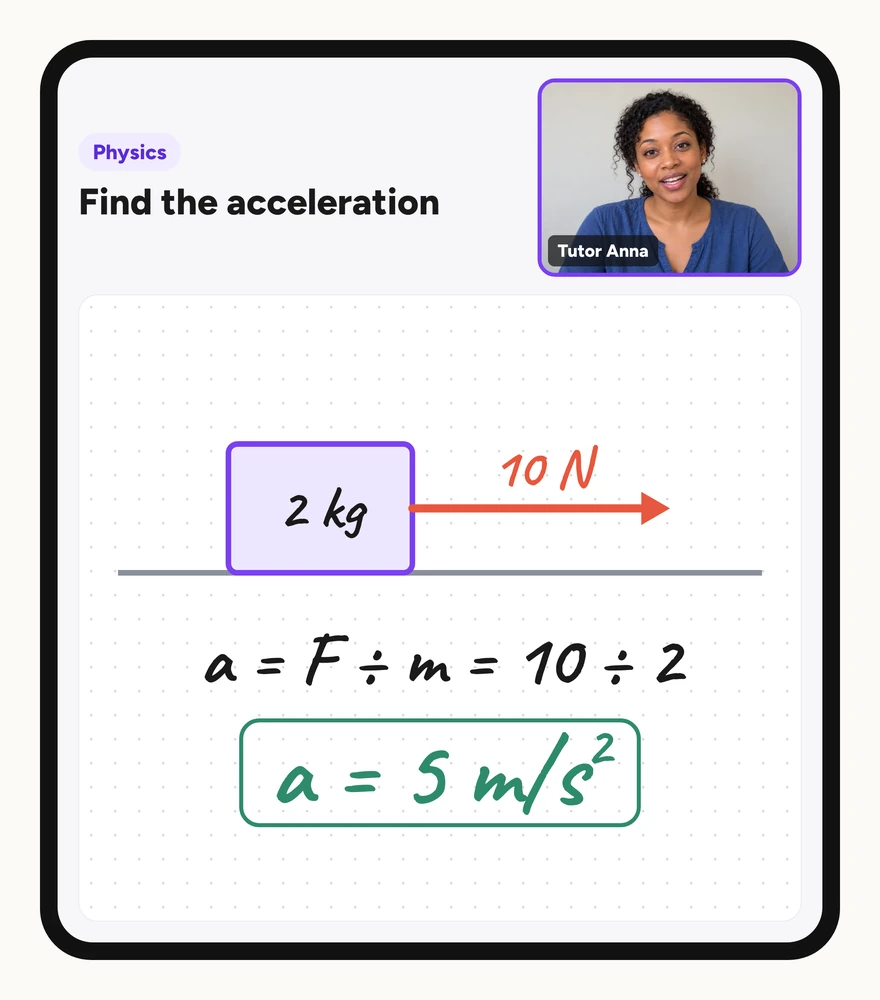
Illustration of an online physics lesson: a tutor on video and a 10-newton force pushing a 2-kilogram block, giving an acceleration of 5 m/s².

Her tutor has been wonderful and so patient — Sarah M

Try a class

Top Physics Tutors

4 of 5 tutors shown · 5.0 avg rating from 1,100 reviews

Sun
Super tutor

5.0

191 ratings

7 years

Experience

5th - 12th

Available Mon, Tue, Wed, Thu, Fri, Sat

Hi! I’m a certified flight instructor and an Astrophysics major from UCF. I have extensive experience teaching both academic STEM subjects and…

7th - 12th

7 days a week

Elementary/Middle School Math & Algebra While I haven't been the classroom teacher for elementary or middle school math, I've been tutoring students…

All grades

Available Mon, Tue, Wed, Thu, Fri, Sat

Can support: ADHD, Dyslexia, ESL ...

I like to make learning fun with games and activities. Once I get to know the students better I can incorporate their interests into my lessons to…

4th - 10th

7 days a week

Can support: ADHD, Dyslexia, ESL ...

With 15 years of teaching experience, I’ve had the joy of working with wonderful kids in diverse places like New York and the bustling cities of…

What parents are saying about Physics tutoring

Paul L is an excellent and very knowledgeable Physics teacher. He was able to help my nephew, who struggled in his physics classes improve h... is grades from the 50s and 60s to the 90s. I would certainly recommend him.

Angela - 10th grade, Physics

I was honestly blown away by Ms. Michelle. She expressed a great deal of warmth and patience. Her skill set is clear and she gets right into... it. We're scheduling obviously!

Dinah - 12th grade, Physics

My son had a very beneficial meeting with Ms.Tessy. She really put the time and effort to understand what he knew and didn’t know, and reall... y walked us through what was gonna happen in the future which I really appreciate.

Raghda - 10th grade, Physics

Physics tutoring that connects formulas to physical reasoning

Students may memorize Newton's laws or kinematic equations and still get stuck deciding which formula applies or what a negative sign means. A graph can look like a collection of lines; a free-body diagram can become arrows without clear reasoning about balanced or unbalanced forces. Physics tutoring can start with the exact point where the calculation or concept stops making sense.

Tutors can connect written equations to diagrams, motion graphs, and real-world scenarios. Students might draw forces acting on an object, interpret the slope or area of a graph, or explain why inertia depends on mass. The aim is to give students a way to reason through the setup and check whether the answer fits the physical situation, alongside practicing the calculation.

Why families look for Physics support

Formulas are memorized, but the reasoning is unclear

Students may recall an equation without understanding when it applies or what each variable represents. Tutors can ask students to explain what a formula describes in a specific scenario, connect it to a diagram, and check units to ensure the calculation matches the physical situation.

Graphs and diagrams feel disconnected from the problem

A velocity-time graph or free-body diagram can appear abstract. Tutors can help students interpret slope and area on motion graphs, identify forces acting on an object, and use those representations to set up equations. The diagram becomes a tool for reasoning, not just a required sketch.

Where students can get stuck in Physics

Confusing distance with displacement, or speed with velocity

Distance measures total path length; displacement measures net change in position with direction. If a student walks six meters east then two meters west, the distance traveled is eight meters, but the displacement is four meters east. Speed is a scalar; velocity includes direction and can be negative.

Misinterpreting slope and area on motion graphs

On a position-time graph, slope represents velocity. On a velocity-time graph, slope represents acceleration and area under the curve represents displacement. Students may confuse which graph they are reading or assign time values to unlabeled grid intervals, leading to incorrect interpretations.

Treating normal force as simply opposite to gravity

Normal force acts perpendicular to the contact surface, which means it points opposite to gravity only on a horizontal surface. On an inclined plane, normal force is perpendicular to the slope, not vertically upward. This distinction matters when drawing free-body diagrams and calculating net force.

Forgetting units or using incorrect exponents

Acceleration has units of meters per second squared, not meters per second. Students may write the correct numerical answer but omit the squared unit, or use minutes directly in a formula that requires seconds. Checking that units match on both sides of an equation can catch these errors.

Applying Newton's third law without recognizing different objects

Action-reaction pairs are equal in magnitude and opposite in direction, but they act on different objects and therefore do not cancel. When a hand pushes a book, the book pushes back on the hand with equal force. Students may incorrectly add these forces when analyzing motion of a single object.

How Physics tutors make the next step clearer

Define key terms before solving the problem

Writing down definitions can clarify what a question asks and prevent confusion during problem solving. For example, stating that inertia is resistance to change in motion helps explain why a more massive object is harder to accelerate or turn. Tutors can ask students to define terms in their own words, then apply those definitions to a specific scenario.

  1. Write the definition of the key concept, such as Newton's first law or inertia.
  2. Identify the given information and what the question asks.
  3. Connect the definition to the scenario, explaining how it applies.
  4. Set up the calculation or reasoning with units clearly labeled.

Use diagrams to organize forces and motion

A free-body diagram shows all forces acting on a single object, with arrows indicating direction and relative magnitude. Tutors can help students draw gravity, normal force, applied force, tension, or friction as appropriate, then calculate net force by adding vectors. For motion graphs, students can identify what each axis represents and interpret slope or area to find velocity, acceleration, or displacement.

Check whether the answer fits the physical situation

A negative acceleration when an object slows down, or a larger force for a more massive object, can confirm that the calculation makes sense. Tutors can ask students to estimate a reasonable range, verify units, and explain what the sign or magnitude tells them about the motion or forces. This reasoning step helps catch setup errors before moving to the next problem.

Putting Physics skills into practice

From a motion description to a graph interpretation

An object moves at constant speed, then speeds up. On a velocity-time graph, constant speed appears as a horizontal line; speeding up appears as a line sloping upward. Students can sketch the graph, identify which section shows acceleration, and calculate displacement from the area under the curve. Tutors can check that students distinguish this from a position-time graph, where a curve indicates changing speed.

From mass and gravitational field strength to weight

Weight equals mass times gravitational field strength. On Earth, a twelve-kilogram backpack has weight equal to twelve kilograms times 9.8 meters per second squared, or approximately 118 newtons. Students can explain that weight is a force measured in newtons, while mass measured in kilograms does not change when the object moves to another planet. To find weight on a different planet, use the same mass with that planet's gravitational field strength.

Inside a 25-minute session

What a Physics tutoring session can look like

This illustrative lesson focuses on interpreting a velocity-time graph and calculating displacement from area. Tutors can choose a different topic, such as free-body diagrams or Newton's laws, and adjust the pace to match the student's current work.

  1. 0–3 min

    Identify the graph type and axes

    Confirm that the vertical axis represents velocity and the horizontal axis represents time. Check units and clarify what a horizontal line, upward slope, or downward slope indicates about the object's motion.

  2. 3–8 min

    Interpret slope for acceleration

    Select a section where the line slopes upward. Calculate acceleration using rise over run: change in velocity divided by change in time. Discuss what a positive or negative slope means for speeding up or slowing down.

  3. 8–15 min

    Calculate displacement from area

    Identify a triangular or rectangular region under the curve. Use the appropriate area formula, such as one-half base times height for a triangle. Explain that this area represents displacement, and check units to confirm the result is in meters.

  4. 15–22 min

    Try a related section of the graph

    Move to a different time interval. Students calculate area independently, add it to the previous displacement if needed, and explain what the total represents about the object's position.

  5. 22–25 min

    Check reasoning and choose next practice

    Review what slope and area tell us on a velocity-time graph. Verify units and signs, then choose another graph interpretation problem or return to definitions if the concept remains unclear.

Example timings only. The topic, depth, and pace can change with the student's needs and prior experience.

Frequently Asked Questions

Terms of servicePrivacy PolicyNotice at Collection

© 2026 ClassDojo. All Rights Reserved.